
Disclaimer: The following content is for informational and educational purposes only. It does not constitute medical or legal advice. 7-Hydroxymitragynine (7-OH) is a potent alkaloid derived from the Kratom plant. Its legal status varies by jurisdiction and is subject to change. Always consult with a healthcare professional before using any botanical substance.
In the shadowy corners of the wellness industry, a quiet revolution is taking place. While regulators and lawmakers are busy fighting the last war against traditional Kratom leaf, a new, more potent player has entered the arena. It’s not a synthetic street drug cooked up in a clandestine lab, nor is it a prescription pill locked behind a pharmacy counter. It is 7-Hydroxymitragynine, commonly known as 7-OH, and it is currently exploiting one of the most fascinating legal loopholes in modern drug policy.
For years, the Kratom community has walked a tightrope. On one side, passionate advocates claim the plant is a life-saving natural remedy for chronic pain and opioid withdrawal. On the other hand, the FDA and DEA have repeatedly attempted to classify it as a Schedule I substance, citing its potential for abuse. But while the government was focused on the raw leaf, science moved forward. By isolating and extracting specific alkaloids, manufacturers have created products that don’t just mimic the effects of traditional opioids—they rival them.
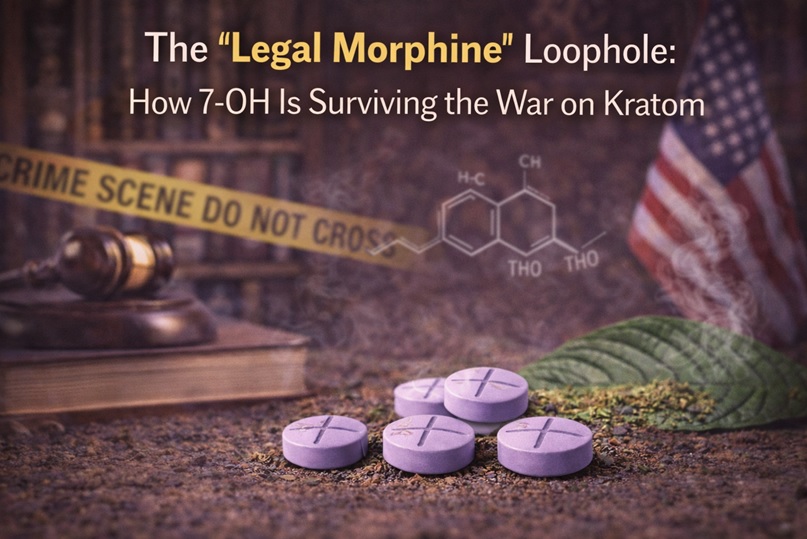
This is the story of the “Legal Morphine” loophole: how 7-OH is surviving the war on Kratom, why it works so well, and the regulatory cat-and-mouse game that threatens to shut it all down.
The Science of the Loophole: Why 7-OH is Different
To understand the loophole, you have to understand the plant. Mitragyna speciosa (Kratom) contains over 40 different alkaloids. The most abundant is Mitragynine, which makes up about 66% of the alkaloid content in the leaf. This is what you get when you buy standard Kratom powder at a gas station or head shop. It’s a partial opioid agonist, meaning it binds to the mu-opioid receptors in the brain but doesn’t fully activate them. It provides mild pain relief and a caffeine-like energy boost.
7-Hydroxymitragynine (7-OH) is different. It exists in the raw leaf in only trace amounts—often less than 0.02%. However, it is significantly more potent. Research suggests that 7-OH is roughly 13 times more potent than morphine and significantly more powerful than Mitragynine itself.
Here lies the loophole: Most legislation targeting Kratom focuses on the plant material itself or Mitragynine specifically.
When lawmakers draft bills to ban or regulate Kratom, they often define “Kratom products” based on the concentration of Mitragynine. They rarely account for products that isolate and concentrate the minor alkaloids. By extracting 7-OH and synthesizing it from Mitragynine (a process that occurs naturally in the body but can be accelerated in a lab), manufacturers can create a product that is technically derived from a legal plant but offers a potency profile that completely bypasses the “mild” reputation of traditional Kratom.
It is, in essence, a super-charged version of the plant that slips through the cracks of current drug laws. It’s not a synthetic opioid like Fentanyl; it’s a natural alkaloid. But its effects are anything but subtle.
The “Legal High” Reality Check
Let’s be brutally honest: people aren’t just buying 7-OH for “wellness.” While many legitimate users find it to be a miracle for severe chronic pain that Tylenol can’t touch, a significant portion of the market is looking for a legal high.
The effects of pure 7-OH tablets are distinct from raw Kratom. Users report a profound sense of euphoria, heavy sedation, and intense analgesia (pain relief) that feels remarkably similar to prescription hydrocodone or oxycodone. Because it is a full agonist at the mu-opioid receptor (unlike the partial agonist Mitragynine), it hits harder and faster.
For someone living in a state where cannabis is illegal or who cannot access prescription pain management due to the strict CDC guidelines on opioids, 7-OH becomes the “Legal Morphine.” It is accessible, effective, and—for now—technically legal in most states.
This reality creates a massive paradox for the industry. To survive, vendors must market 7-OH as a safe, natural supplement. They use words like “botanical,” “tea,” and “wellness support.” But the subtext is clear to anyone paying attention: This is the strong stuff. It’s the product you buy when the regular green sludge doesn’t cut it anymore.
The Regulatory Cat-and-Mouse Game
The existence of 7-OH products is a direct challenge to regulators. The FDA has long maintained that Kratom has no approved medical use. However, the Kratom Consumer Protection Acts (KCPAs) passed in various states were designed to protect access to the natural plant while ensuring purity standards.
These laws were written with traditional Kratom powder in mind. They mandate labeling requirements and set age limits, but they didn’t anticipate the rise of isolated alkaloid tablets. Now, regulators are scrambling to catch up.
We are seeing a classic game of regulatory whack-a-mole:
- The “Adulteration” Argument: Some states are trying to classify 7-OH extracts as “adulterated” Kratom products because the alkaloid ratios don’t match the natural plant. If a tablet has 15mg of 7-OH and almost no Mitragynine, is it still Kratom? Or is it a drug?
- The Synthesis Ban: Some jurisdictions are moving to ban “synthetic” Kratom alkaloids. The industry argues that since 7-OH is naturally occurring, extracting it isn’t synthesis. However, because it’s often converted from Mitragynine in a lab to achieve high yields, the line between “natural extraction” and “semi-synthetic manufacturing” is blurry.
- Total Bans: In states like Alabama, Arkansas, and Indiana, Kratom is banned entirely. In these places, the loophole is closed. But in the rest of the country, the gray market thrives.
The Double-Edged Sword for Consumers
For the consumer, this loophole is a double-edged sword.
On one hand, it provides access to powerful pain relief without the stigma or legal risk of street drugs. For a chronic pain patient who has been cut off by their doctor, 7-OH can be a lifeline. It allows them to function, work, and live without debilitating pain.
On the other hand, the lack of regulation means the market is the Wild West. Because 7-OH sits in this legal gray area, quality control is voluntary.
- Inconsistent Potency: One vendor’s “15mg tablet” might knock you out, while another’s does nothing.
- Contaminants: Without strict oversight, unscrupulous vendors may use dirty solvents to extract the alkaloids, leaving behind toxic residues.
- Tolerance and Dependence: Because 7-OH is so potent, tolerance builds rapidly. Users who switch from powder to tablets often find that their regular Kratom dose no longer works. The withdrawal from high-dose 7-OH can be significantly more intense than withdrawal from plain leaf, mirroring the symptoms of traditional opioid withdrawal.
The Future of the Loophole
How long will the “Legal Morphine” loophole remain open? It’s hard to say.
The Kratom industry is currently fighting a war on two fronts. They are battling the FDA at the federal level while simultaneously trying to police their own bad actors to avoid giving regulators ammunition.
Products like high-dose 7-OH tablets are the industry’s biggest liability and its biggest moneymaker. They attract the kind of attention that gets substances banned. If a high-profile adverse event occurs—an overdose, a hospitalization, a media scare story—lawmakers will not hesitate to close the loophole.
For now, 7-OH remains legal in most of the United States. It sits on shelves next to CBD gummies and energy shots, a quiet powerhouse hiding in plain sight. It is the ultimate test of our drug laws: a natural substance that defies easy categorization, challenging our definitions of “medicine,” “drug,” and “supplement.”
If you choose to explore this loophole, do so with your eyes open. You aren’t just taking a herbal supplement; you are participating in a regulatory experiment. Respect the potency, understand the risks, and know that in the world of gray-market botanicals, the only guarantee is that nothing stays the same for long.
Looking for premium, lab-tested 7-OH products that set the standard for purity? Explore the collection at 7oh.com.
