
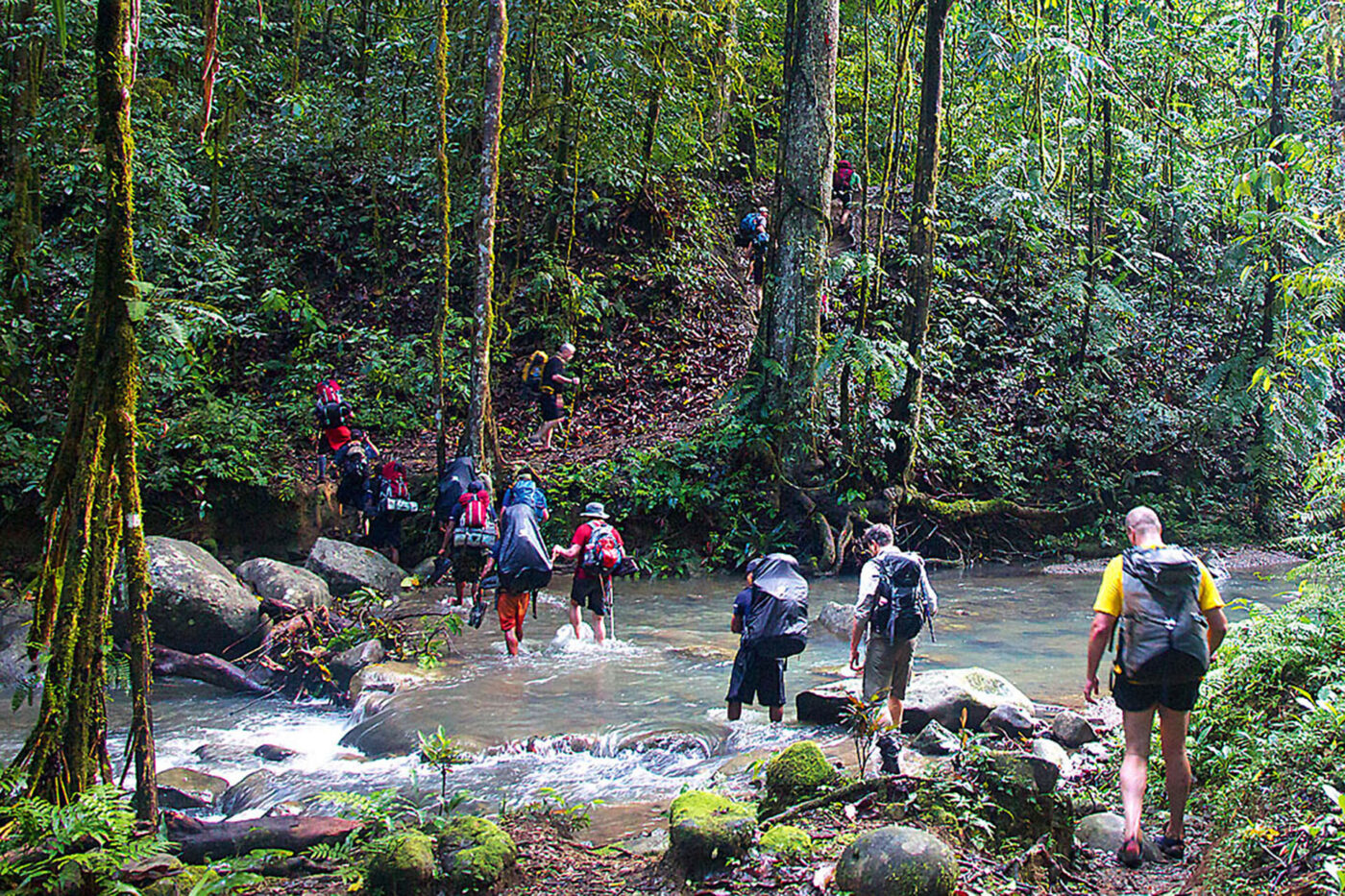
The 96-kilometer crossing of the Owen Stanley Range attracts steady misinformation through forums, Facebook groups, old blog posts, and secondhand retellings. Some claims overstate the difficulty, and others understate the logistics.
“You need to be an elite athlete”
The track is a hard walk, and that part of its reputation is accurate. Steep climbs and humid air are real, and the effort repeats day after day. But hard does not mean elite.
Most people who finish are ordinary walkers. Preparation matters more than natural athleticism. A person who spends the months before departure walking hills with a loaded pack and climbing stairs is well placed. A gym-fit person who skips that specific work often finds the descents harder than expected.
Guided itineraries are built around ordinary fitness. Daily distances stay within reach, and the guide sets a steady pace with planned rest stops.
Many operators ask about training habits before taking a booking. Trekking poles are common because wet descents are hard on knees.
Back-to-back days are the part training should copy. The body has to walk well again each morning, so weekend walks on consecutive days teach more than one long session. Consistency across months beats one hard week of cramming.
The track demands respect and consistent training, but ordinary fitness, properly prepared, is enough.
“It’s just a history walk”
The history is the reason many people book, and most itineraries stop at Isurava Battlefield and Brigade Hill, sites from the 1942 Kokoda Campaign. That focus leads some first-timers to picture a gentle stroll between memorials.
The walking itself is the other half of the experience. The track runs about 96 kilometers from Owers’ Corner in the south to Kokoda Village in the north, and it crosses the Owen Stanley Range along the way. The route climbs and descends repeatedly, often on mud, for most of each day.
Most groups walk from south to north, starting at Owers’ Corner and finishing in Kokoda Village, where the 1942 airfield battle was fought. Some itineraries run the other direction. Either way, the distance and the climbing are the same.
Guides tell the campaign’s story at the sites where it happened, and many trekkers find those stops the most affecting part of the walk. A trekker prepared for a stroll will struggle by the second day. A trekker trained for a multi-day hike has enough energy left to take the memorials in.
“You carry everything on your own back”
This misconception comes from photos of hikers bent under heavy expedition packs. Organized treks in PNG don’t work that way.
A guided trek employs local porters and ground crew. Group gear such as tents and cooking equipment travels with the crew, along with food supplies for the whole party. That shared support is part of what the package price pays for.
Personal gear is separate. On many treks, each walker carries clothing, sleeping items, water, and daily essentials in a daypack. Personal carrier support, where a dedicated porter carries one person’s bag, is a different arrangement. It usually needs to be organized in advance and can sit outside the headline price.
The daypack still needs discipline. Water and rain gear add weight quickly, and every extra item is carried for days. Weighing the packed bag before departure removes the guesswork.
Ask before booking what the shared crew carries, what stays on the trekker’s own back, and whether personal carrier support is available at extra cost. Two packages at different prices can give very different answers, and the cheaper one can end up heavier.
“The climbs are all that matter”
Preparation for the Kokoda Track is often framed as training for the climbs. The descents ask as much of the body, and uneven footing under a loaded pack tests balance on every section. The track asks for fitness that lasts over repeated days of walking, not one hard effort.
Preparation should target those conditions. Hill repeats and long pack walks pay off. Anyone managing a health condition should raise the trek with a doctor before booking, which is sound practice for any demanding hike.
“There’s a good season and a bad season”
The trekking calendar often gets described as two neat halves, one good and one bad. The track’s climate doesn’t divide that cleanly.
The route crosses a wet tropical range, and rain can fall in any month. Drier periods lower the odds of heavy rain but do not remove them.
ANZAC Day shows how little the calendar settles. Many Australians choose April departures to commemorate the 1942 campaign. Places on popular departures around that period fill early.
Shoulder months can mean fewer groups sharing the track and campsites. Trekkers who value quiet often accept the higher rain odds that come with them.
Rain changes specific things. Mud gets deeper and river crossings run higher. Drying clothes overnight is never guaranteed.
Quality wet-weather gear and dry bags earn their place in every month of the year. A well-equipped trekker in a wet week has an easier time than a poorly equipped one in a dry week.
“All trek operators are basically the same”
Two websites can show similar photos and near-identical day counts, but Kokoda Track tours can still be very different products.
Start comparison with the headline price. Some packages bundle accommodation and transfers around the walk itself. Others list a lower figure and leave those costs to the trekker.
Personal carrier support, covered above, may or may not be included. Line up the price, the inclusions, the payment schedule, and the cancellation terms before deciding anything.
The same questions apply to any kokoda trek: what happens if a walker cannot continue, and what insurance each side holds. Clear written answers are a good sign. Vague ones are information too.
Then look at the people. Ask who leads the group and how many times that person has walked the track. Ask how large the local crew is and how the company supports the villages along the route. The track runs through communities whose land and labor make trekking possible, and operators differ widely in how they respond.
Group size deserves a question too. A large group moves at a different pace from a small one, and the feel of the trek changes with it. Some companies also provide training guidance before departure, which helps first-timers prepare with purpose.
Different models suit different buyers. A minimal package favors an experienced, self-sufficient walker who wants logistics handled and nothing more. A fully supported package favors a first-timer who wants the walking to be the main job. Neither is automatically better, but paying for one while expecting the other causes problems.
“The faster you finish, the better”
A fast crossing sounds like an achievement, but on this track speed usually costs what people came for.
Standard guided itineraries run about eight or nine days. That schedule keeps daily effort within reach of ordinary fitness and leaves time at the places that give the track its meaning.
There is also a practical cost to speed. Longer days leave less margin for blisters and slow recovery. One hard day can be pushed through, but four in a row is a different problem.
Brigade Hill shows what that time buys. Australian forces made a costly stand there in 1942, and a guide needs an unhurried hour to tell the story where it happened.
Isurava Battlefield and Imita Ridge reward the same unhurried time. Imita Ridge, the battle site closest to Port Moresby, marks where the campaign’s momentum turned.
Village stops matter just as much. The Fuzzy Wuzzy Angels, the Papua New Guinean carriers who helped wounded Australian soldiers, are central to the track’s story, and their descendants live along the route. Time in those villages is exactly what fast itineraries cut.
Shorter crossings suit a narrow group: very fit, experienced walkers with limited time off. For a first-timer, the standard schedule is the product worth paying for.
“You need overseas trekking experience first”
This one stops people who would do fine. The assumption is that Kokoda belongs after Nepal or New Zealand, as a later step in a trekking career.
Plenty of first-timers complete the track every season. For many Australians it is their first multi-day trek, chosen for its history and relative proximity. What they share is preparation done at home: long hill walks with a loaded pack, repeated over months.
A guided itinerary covers much of what experience would otherwise provide. The crew handles camp logistics and the guide sets the daily pace.
The route, campsites, meals, and daily timing are already solved. The trekker’s job is to arrive trained and keep walking.
Experience matters less than honesty about current fitness. The track exposes optimistic self-assessments quickly.
Self-knowledge is the better test. Someone who enjoys long days outside and trains consistently is ready to consider booking. Anyone unsure can try a hard local overnight hike first, and that weekend says more than any forum thread.
Most of these misconceptions share a source: secondhand information from people who trekked years ago or never trekked at all. The corrections are practical. Train consistently and pack for rain in any month. Ask each operator what is included and what support is provided. Then compare current itineraries with those questions in hand.
